


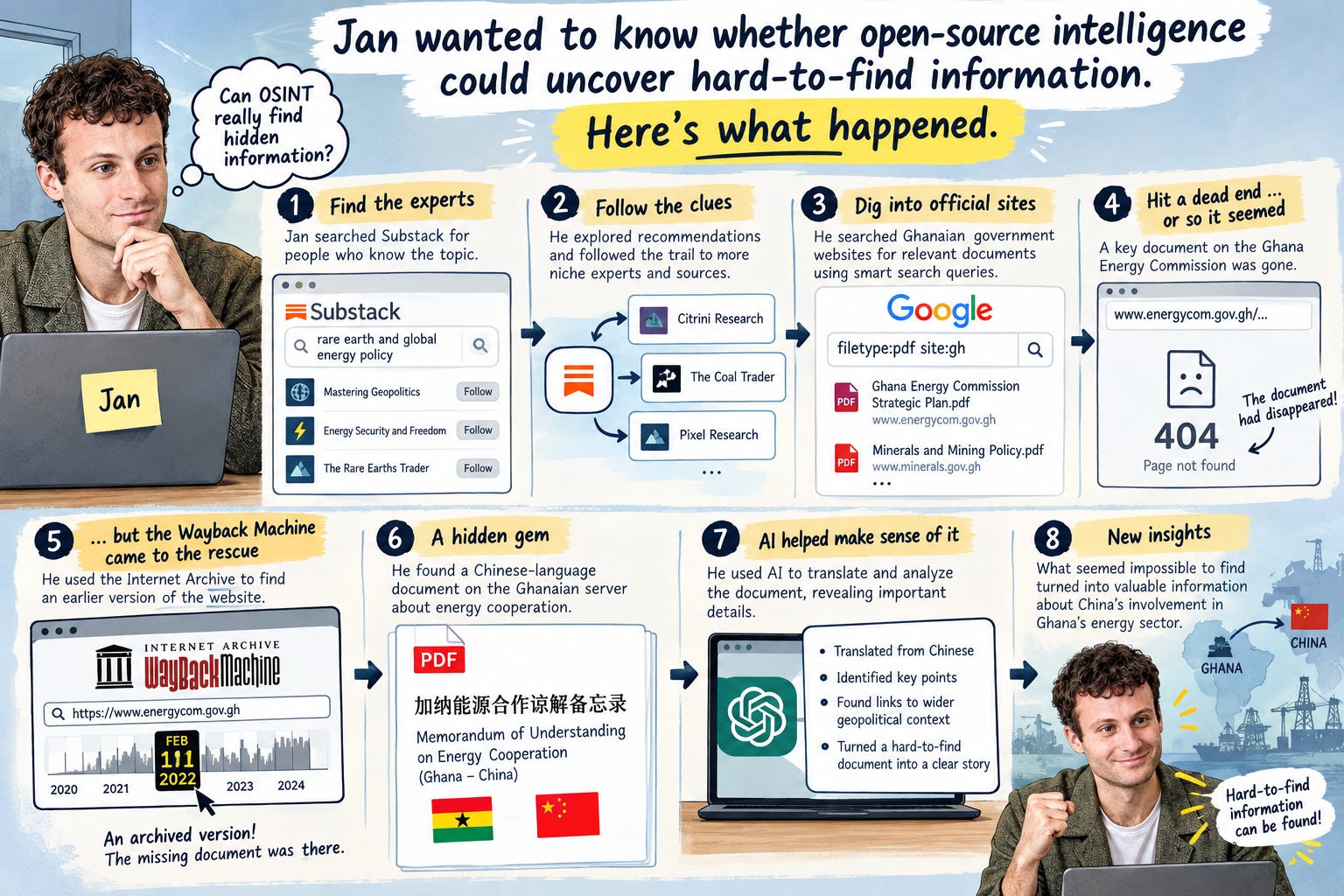
Jan H. Rosenkranz is interested in geopolitics: energy, rare earth materials and similar matters. He wanted to know whether open source intelligence can find hidden information, or information that is hard to get.
“You often come up with new stories by looking at information in a certain way,” he said to me. “I would love to do the same, but on world energy politics.”
I didn’t have an answer right away. I don’t know much about world energy politics. Just the basics: there are seventeen rare earth elements, fifteen lanthanides plus scandium and yttrium, and one of them, promethium, barely exists in nature. The usual small talk.
But that’s trivia. Anyone can look it up. Jan wanted what nobody had looked up yet.
For that, I have two approaches: horizontal and vertical. Horizontal is asking around: who knows more about this than you do? Vertical is picking one thing that matters for the topic and going deep.
Rare earths are a good test case precisely because they’re not mainstream. And when something isn’t mainstream, there’s often more information if you look hard.
The method doesn’t care what you fill in. Rare earths, cobalt, cocoa, a court case, a company. Same steps.
Horizontal: follow the opinion leaders
If you research a topic and want to stay on top of it, you need opinion leaders. The best in class. The people who know more than you and maybe have not many followers yet because they don’t want to be mainstream.
That last part matters. The moment someone is super popular, it screams: okay, this is already well known.
I’ve used many systems over the years to follow those people. Topsy Labs. Klout Score. PeerIndex. Kred. Twitter lists on an off-beat topic. All of them are gone or not helpful anymore. I won’t dwell on the past, because there’s one system that beats every one of them: the newsletter service Substack. Yes, the platform you’re reading right now.
With Jan, I typed “rare earth and global energy policy” into Substack’s search box.
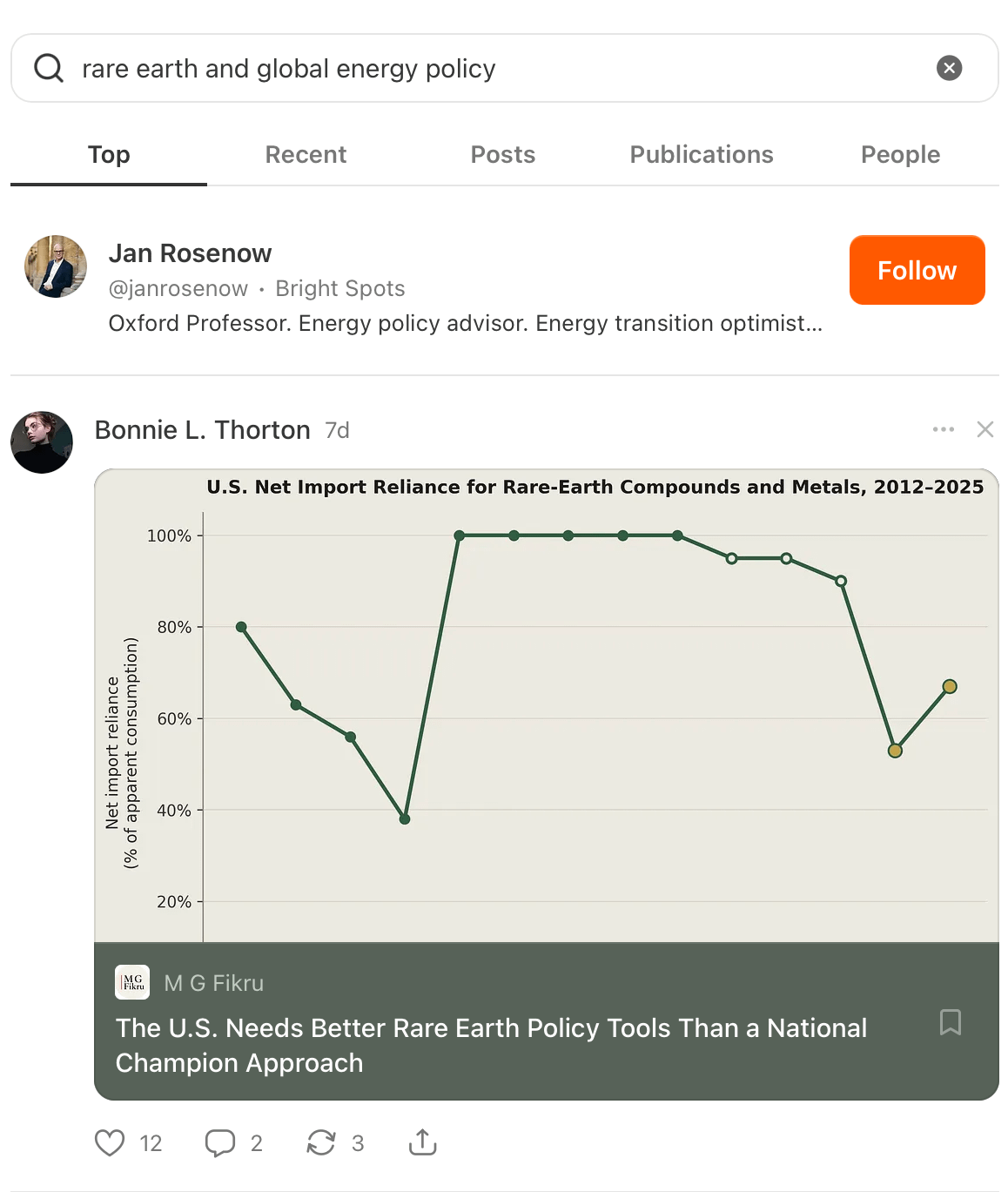
Lots of hits. I asked Jan to click on each of them. Some were off. Some were quite on topic. Mastering Geopolitics. Energy Security and Freedom. The Rare Earths Trader.
Follow the ones that look on topic at first glance, then judge the depth. If you hear something you never knew, like “in Ghana, you can also pay with Chinese currency”, follow that newsletter for a few weeks. Hold on to that currency line. We’ll need it later.
Hop via the recommendations page
When a writer holds your attention, add /recommendations to the address of their Substack. The front page often shows the recommendations too, but without the full description.
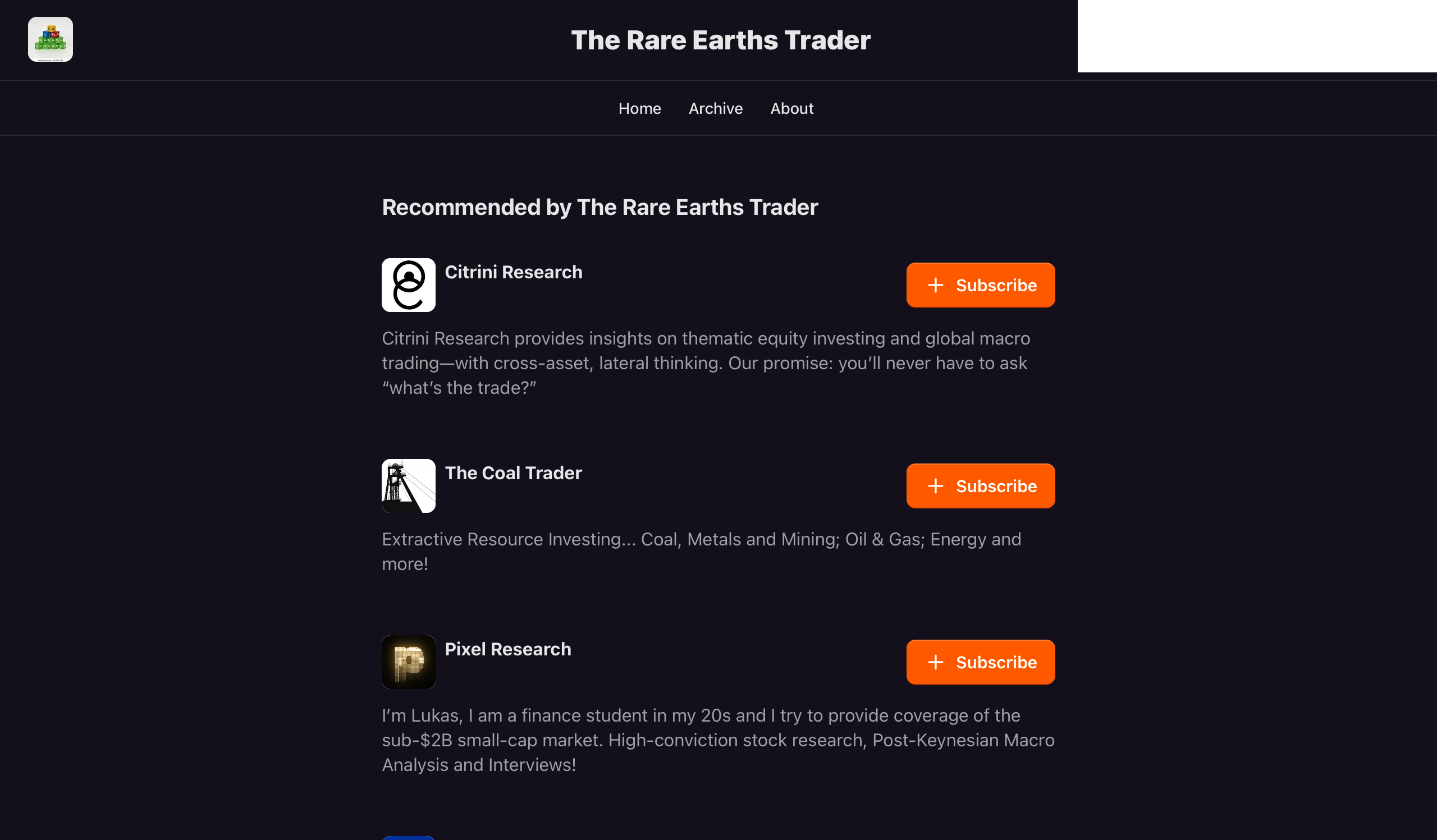
You’ll usually see a list of about five newsletters, recommended by the person you already think highly of. The Rare Earths Trader points to Citrini Research, The Coal Trader and Pixel Research, among others. Click on all of them. Do the same test. Follow the best ones for a few days or a week, then open their recommendations.
As said a moment ago. don’t be too impressed by high follower counts. Some newsletters have only 20 followers because the writer is so on topic that the rest of the world doesn’t care. Those are the ones you want.
Hop from opinion leader to opinion leader. In three or four weeks you usually have a nice collection of people who really know your topic.
Vertical: China is very interested in Ghana
For vertical, you go deep into something that matters for the topic. I went to China, which is very interested in Ghana. So the endgame is: how do we find documents that explain what China is doing in Ghana? What methods do they use to get what they want? Let’s start with finding documents from Ghana first.
Step 1: find the country domain
Type it into Google. Now you know: .gh.
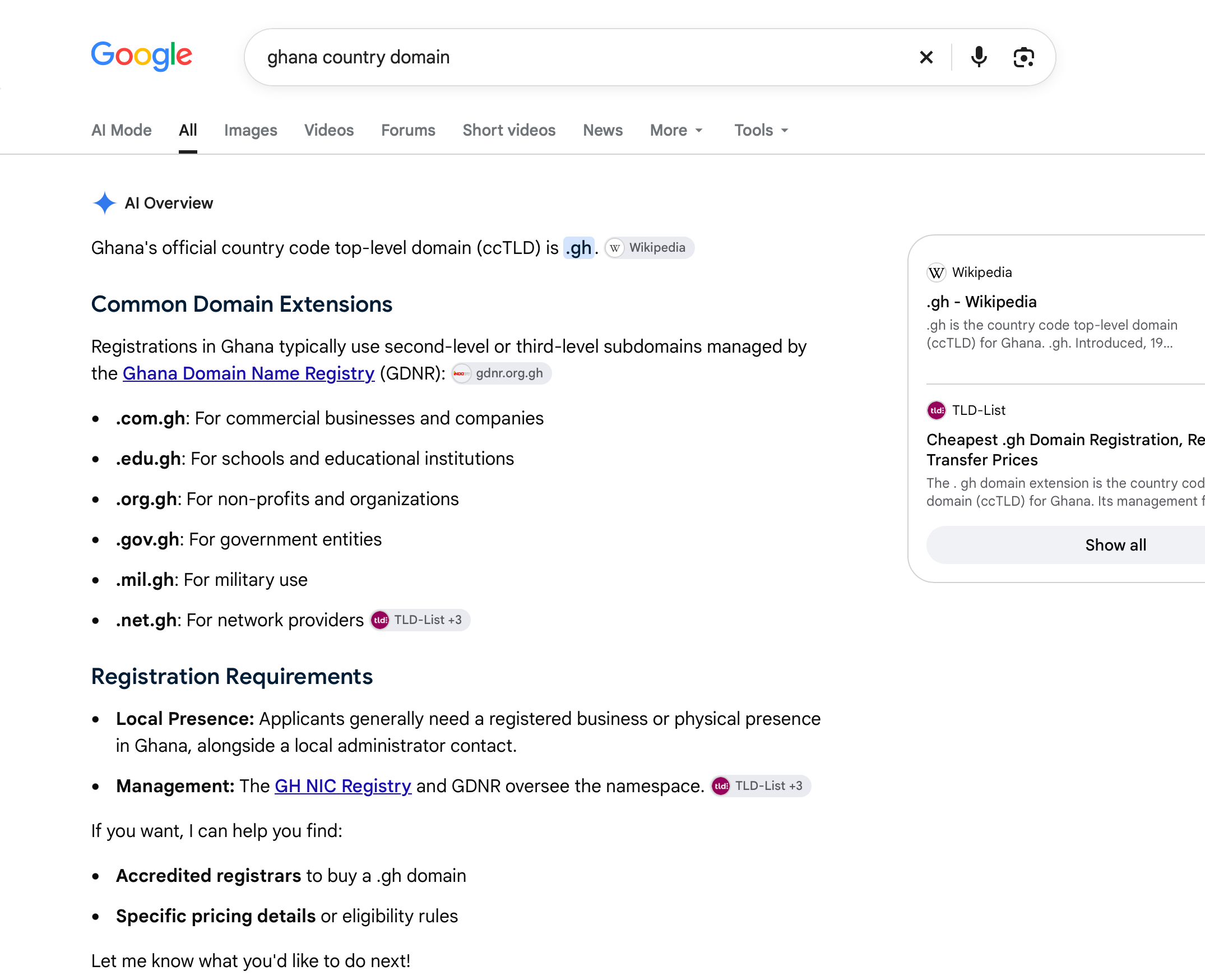
Google also lists the second-level domains, and one of them matters later: .gov.gh for government.
Step 2: search by form factor, not by label
The endgame is documents that talk about China and sit on some kind of official Ghanaian server. Searching for official documents site:gh makes no sense. Not many official documents say that they are an official document.
So look at the form factor. Authorities love a PDF. filetype:pdf site:gh is just a first round, to see whether there’s enough material.
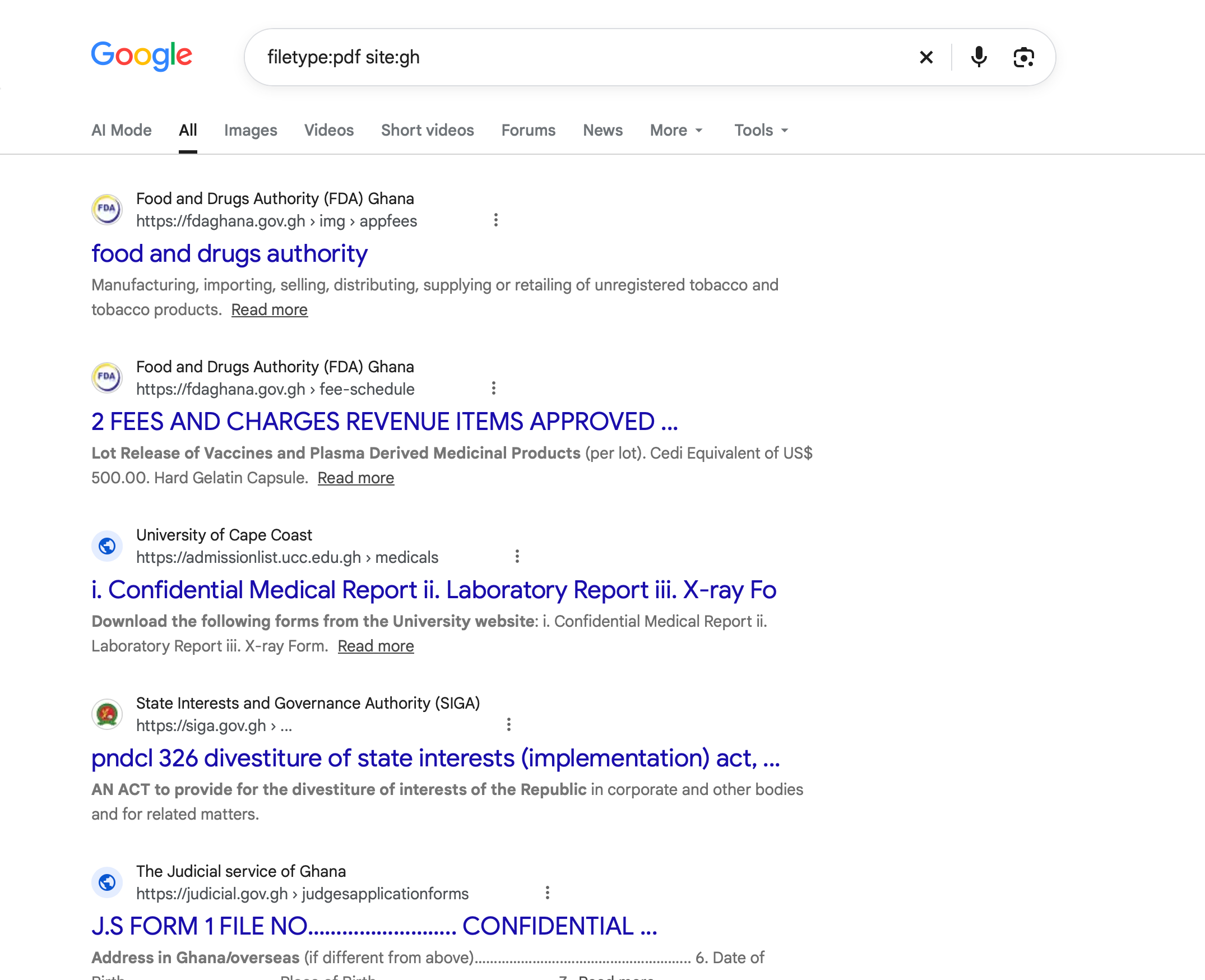
Food and Drugs Authority. University of Cape Coast. The state-holdings agency. The Judicial Service. There’s enough. That’s great.
Step 3: think like a document
I was anxious to know whether there were any Chinese-language documents on Ghanaian servers. You never know how deep the ties go between two countries.
Ask any large language model, or Google Translate, to translate “Chinese” into Chinese.
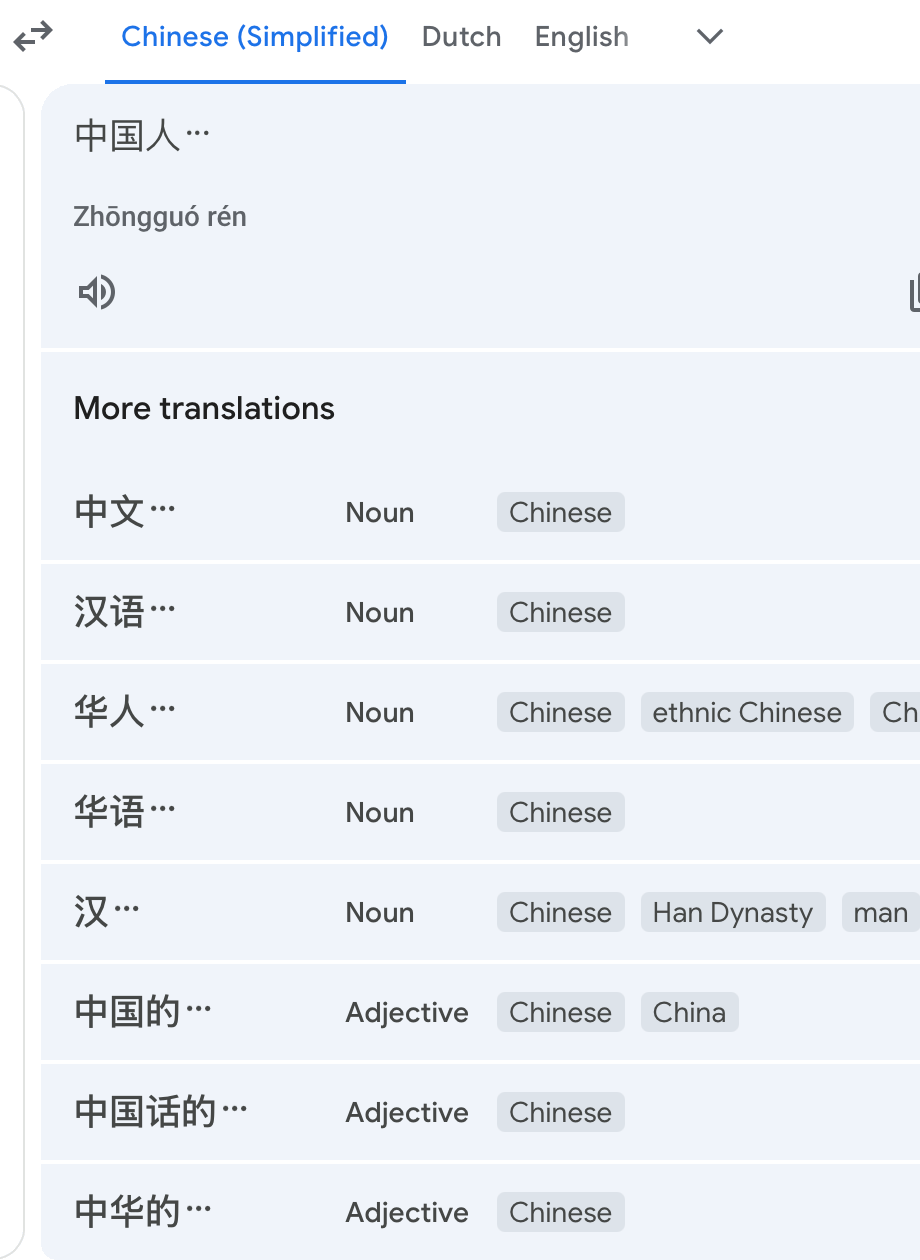
I went for 中国人. Put it in front of the rest: "中国人" filetype:pdf site:gh.
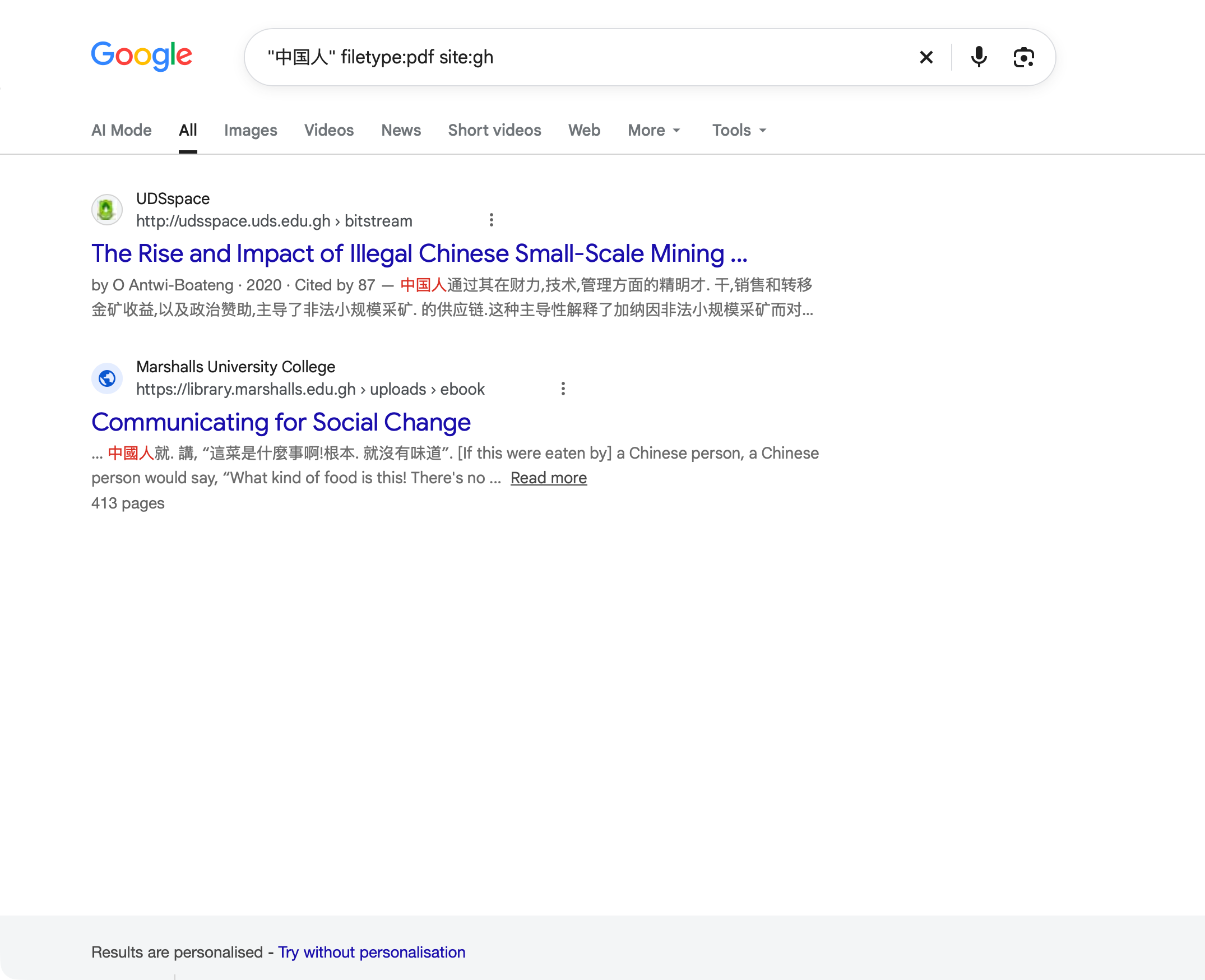
Two hits. The first is a paper on a Ghanaian university server about the rise of illegal Chinese small-scale gold mining (O. Antwi-Boateng, 2020, cited 87 times), with a Chinese summary. At this point Jan was already not unhappy.
It still isn’t super helpful, though. Two hits, and neither is on a government server.
Step 4: drop the quotes, then narrow to government
Next I went for the word China, without quotation marks: china filetype:pdf site:gh. Why no quotes? I also want to see variations of the word. Put a word between quotation marks and Google executes it literally.
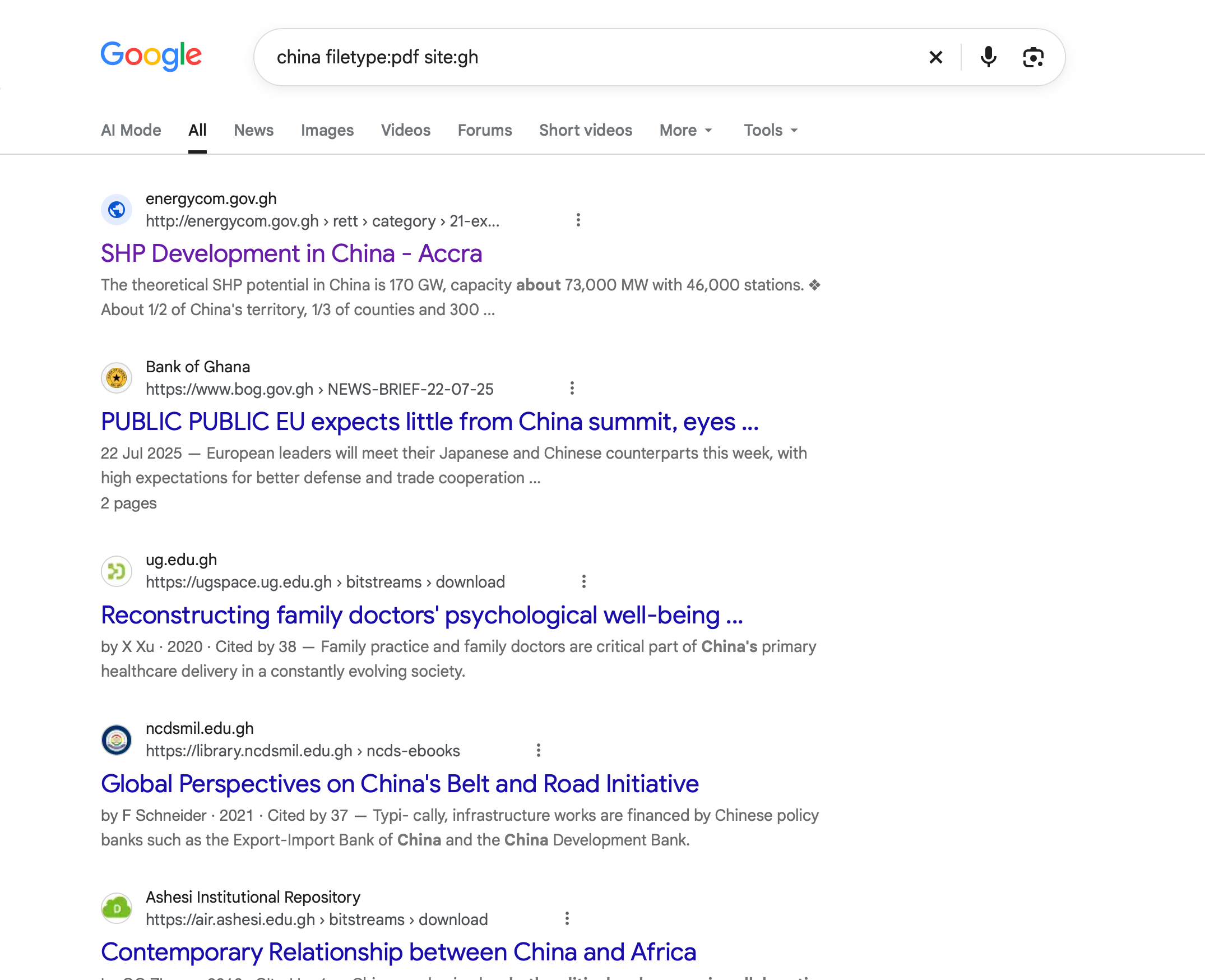
By now I also knew that Ghana’s government websites have their own domain. So I refined the search to that domain: china filetype:pdf site:gov.gh.
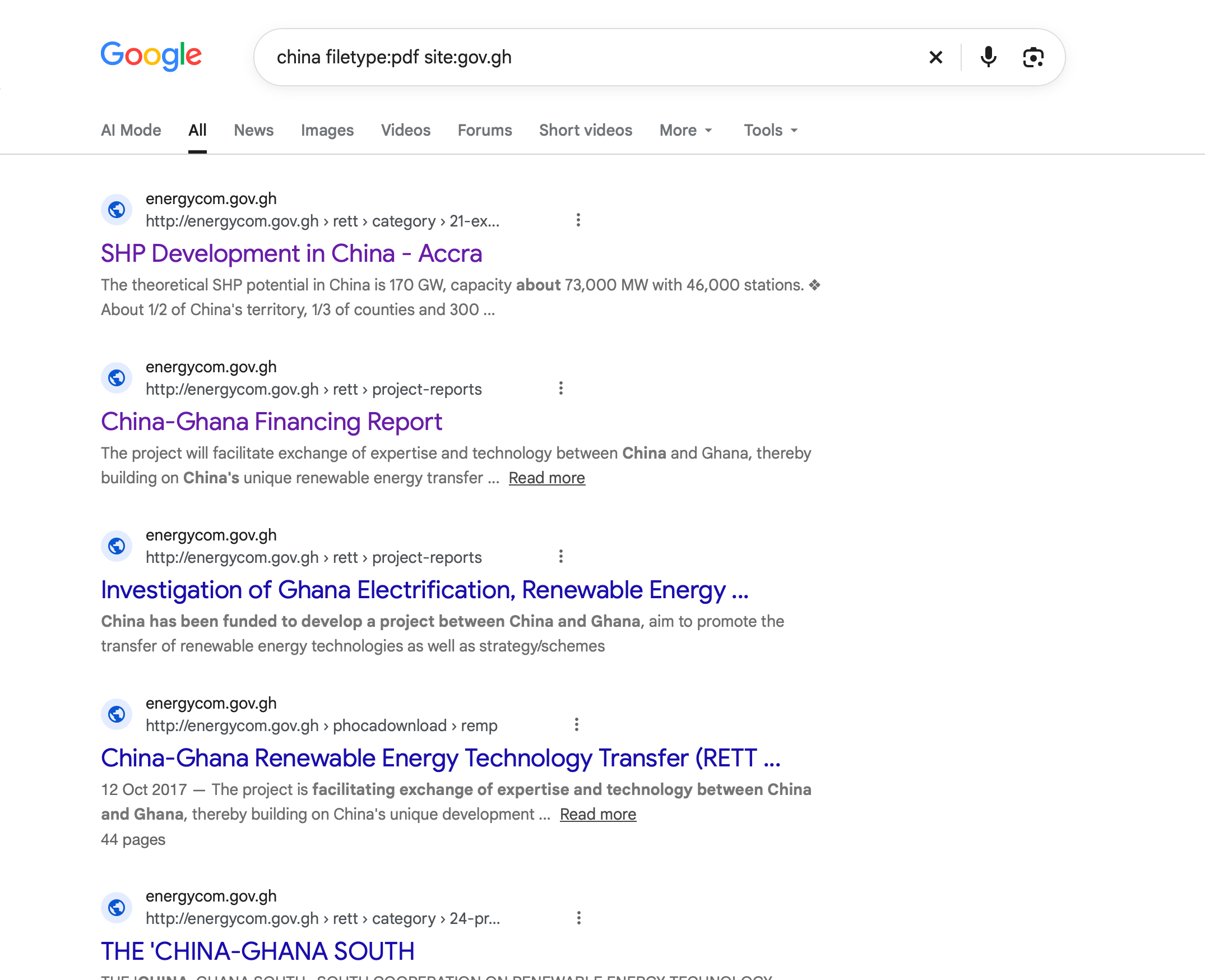
Almost every hit comes from one place: the Ghana Energy Commission, and its RETT project, the China-Ghana Renewable Energy Technology Transfer. China-Ghana Financing Report. An investigation of Ghana’s electrification. And a download link that promises Chinese-commissioned reports.
The Google snippet calls it a “unique renewable energy transfer experience”. Which sounds so happy.
Lost in space
I clicked the link.
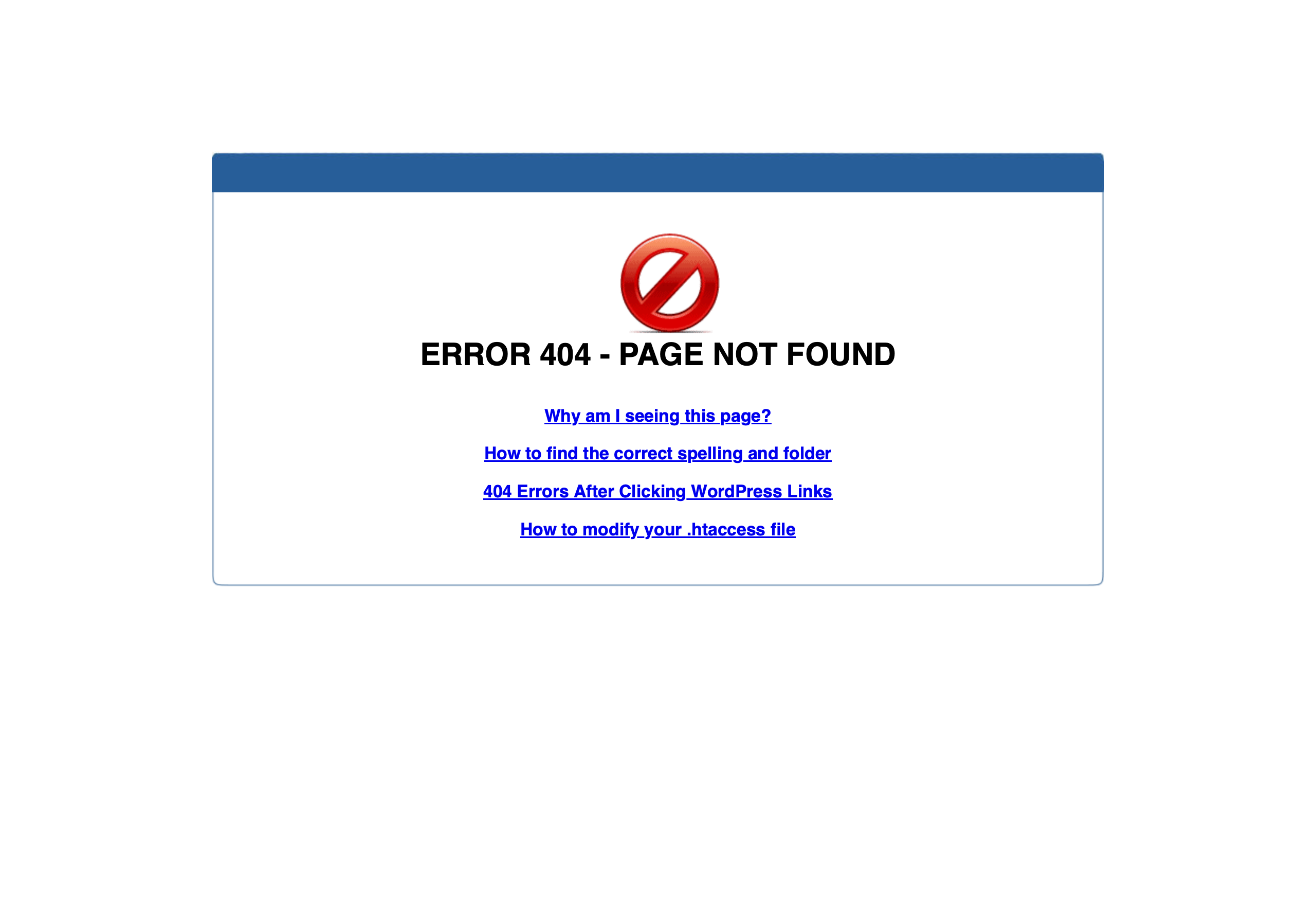
Lost in space. Every hit I tried from that commission was out of order. The download for the experience-sharing workshop didn’t work either.
The information is gone. Finished. Finito. It’s not on the web anymore.
Everyone reading this blog knows the next move: the Internet Archive’s Wayback Machine. Less well known is that you can do more than paste one link and hope a copy exists for a certain year. You can search the link structure.
Type the name of the website and wait. Click URLs and wait even longer. You get a long list of every link the archive ever saw on that site. Then search that list for Chinese or China.
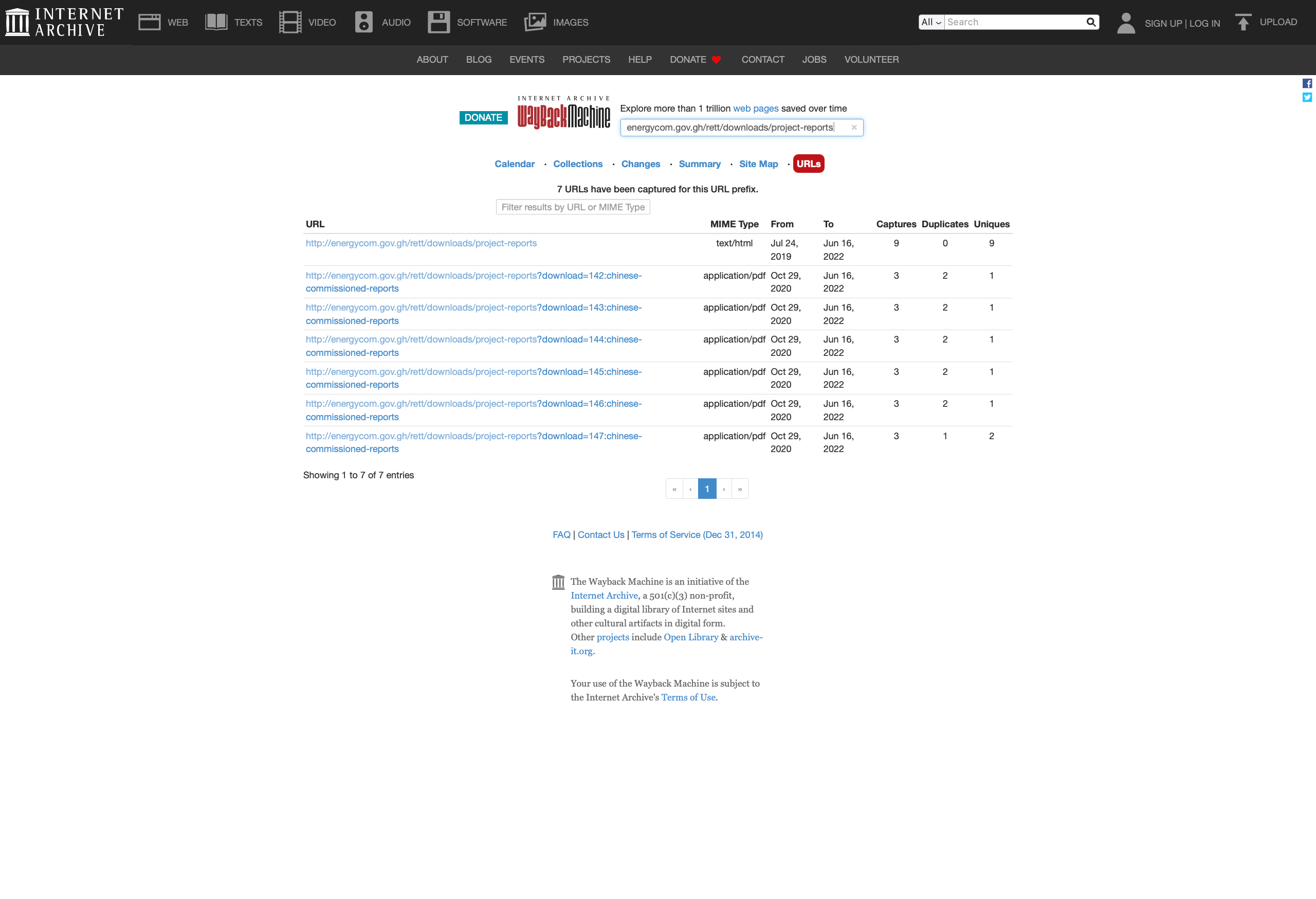
There they are. Seven URLs under the project reports folder, and six of them are PDFs with the same tail: chinese-commissioned-reports, downloads 142 to 147. All six were captured on 29 October 2020.
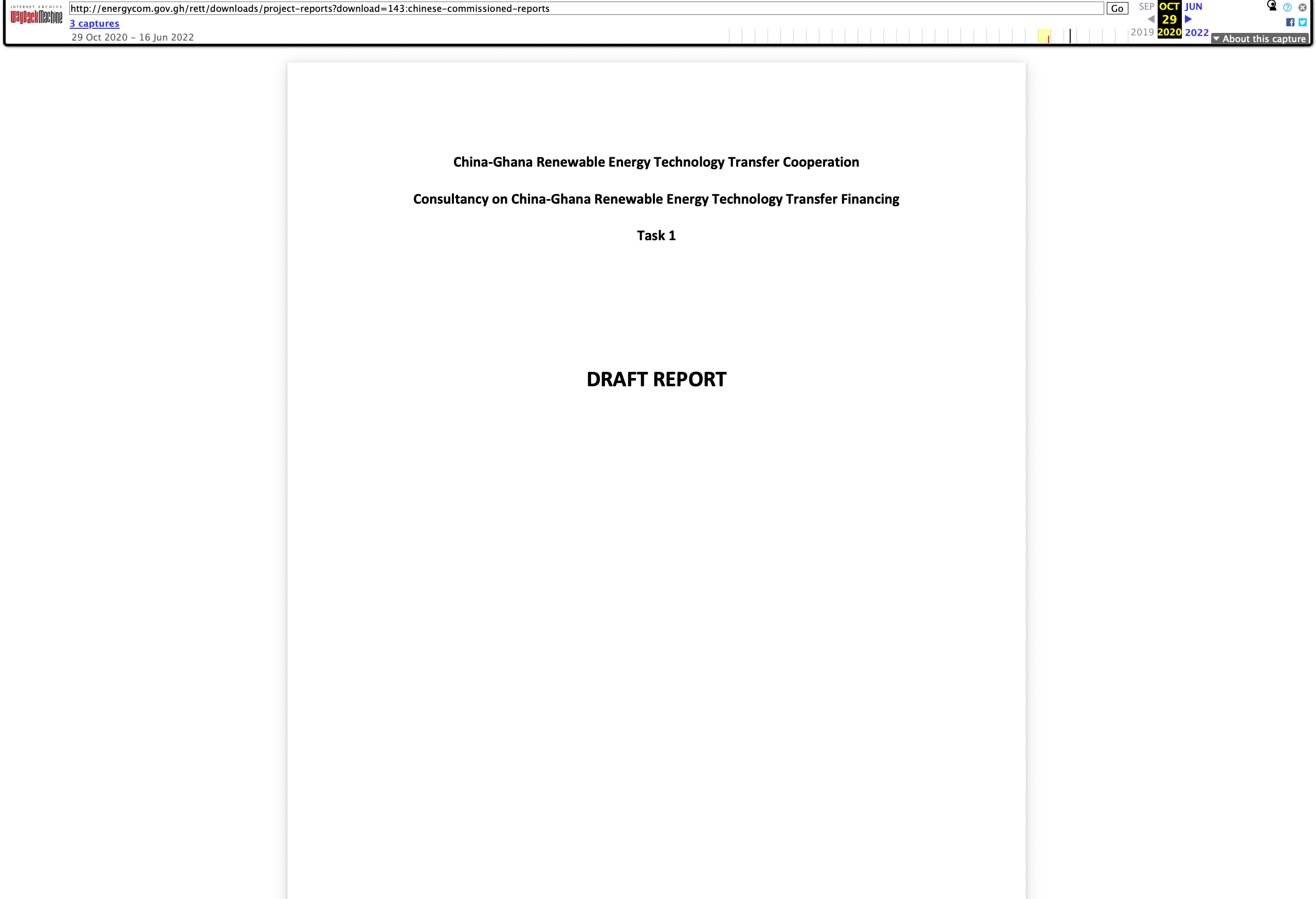
Click one and the dead link comes back to life. I love a good draft report. It enables me to compare it to the final report and see what was deleted.
Step outside the fence
Seeing chinese-commissioned-reports with the hyphens in a URL, my next move was to search for that string without the site:gh thingy. I wanted to know: what are the odds that sites with that phrase in their URL are not about Chinese-commissioned reports? I didn’t want to restrict myself to Ghana. A small step outside your comfort zone shows you whether you’re missing something.
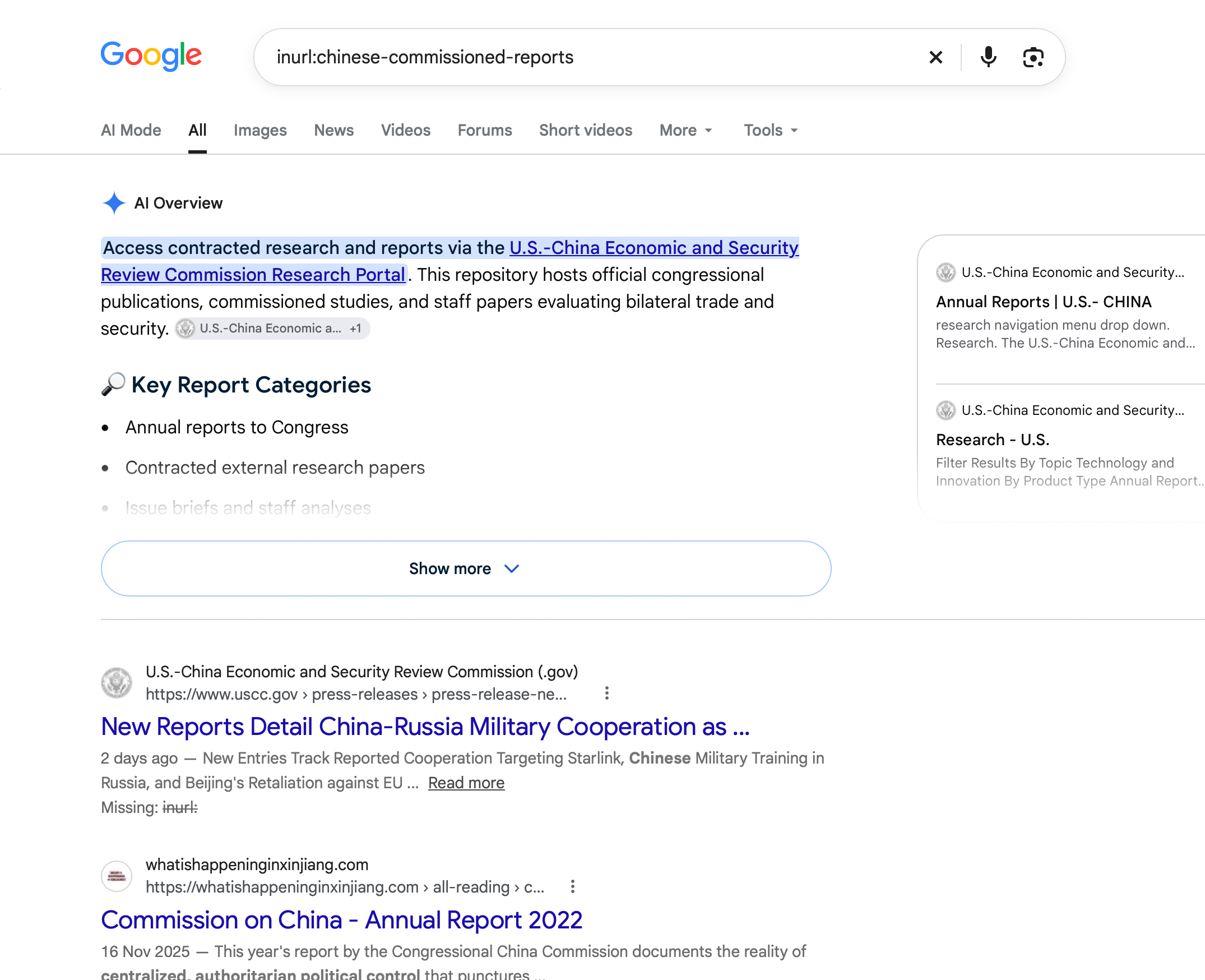
Google shrugged. It dropped the operator (“Missing: inurl”) and handed me the U.S.-China Economic and Security Review Commission. Outside Ghana, that URL string leads nowhere. That’s an answer too: Google isn’t executing inurl correctly anymore. So I went for plan B:
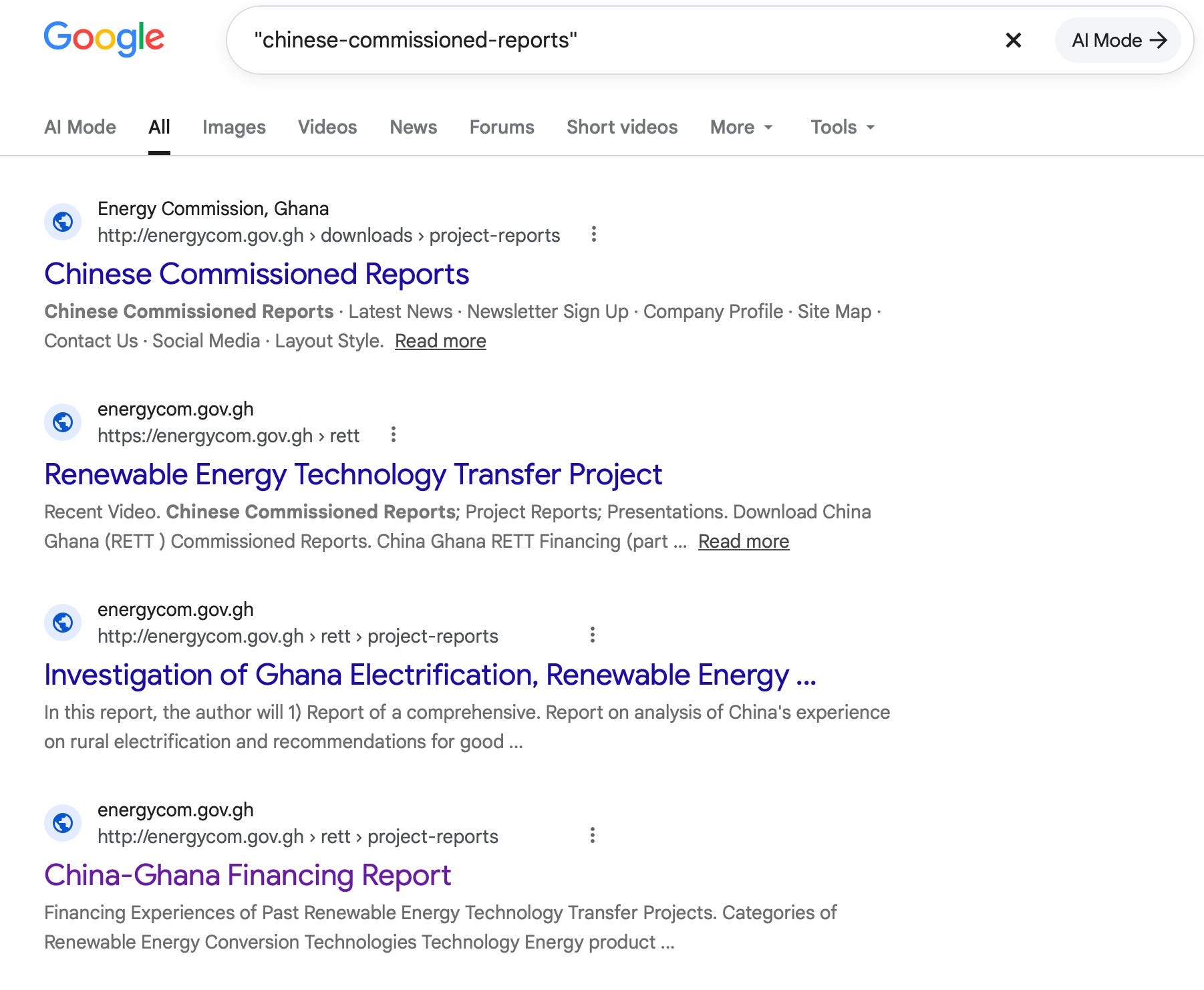
Flip it: what does Beijing say about Ghana?
Now do the whole thing once more, from the other side. That perspective will probably give you far more information.
Translate the country: Ghana becomes 加纳.
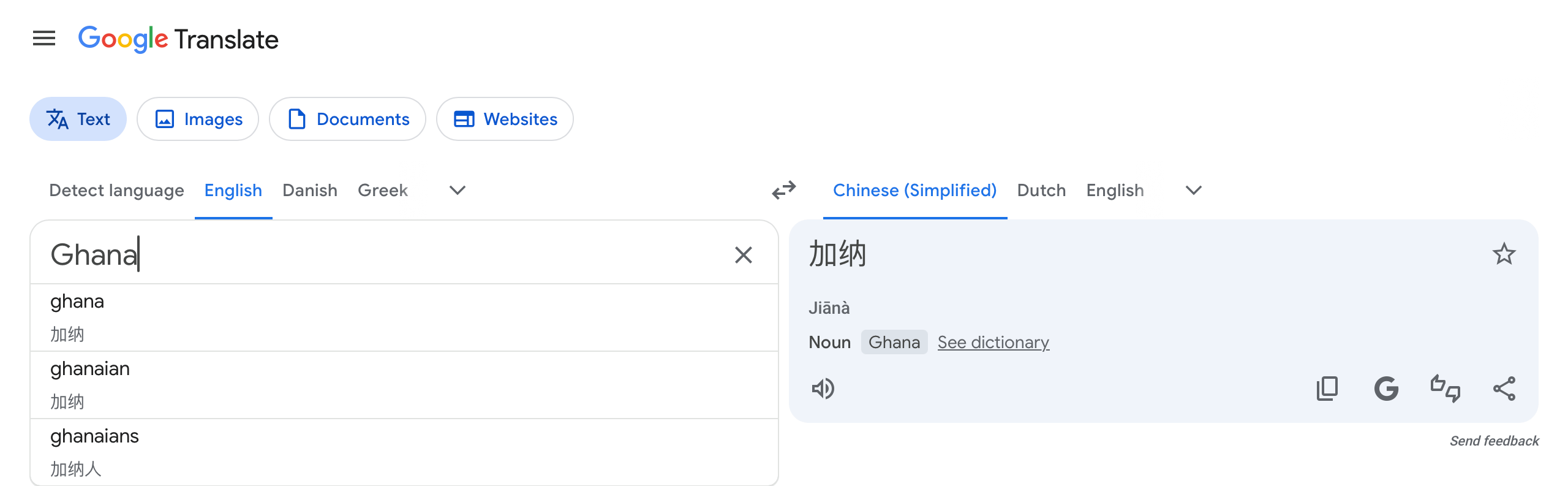
Then ask what the Chinese government publishes about Ghana: "加纳" filetype:pdf site:gov.cn.
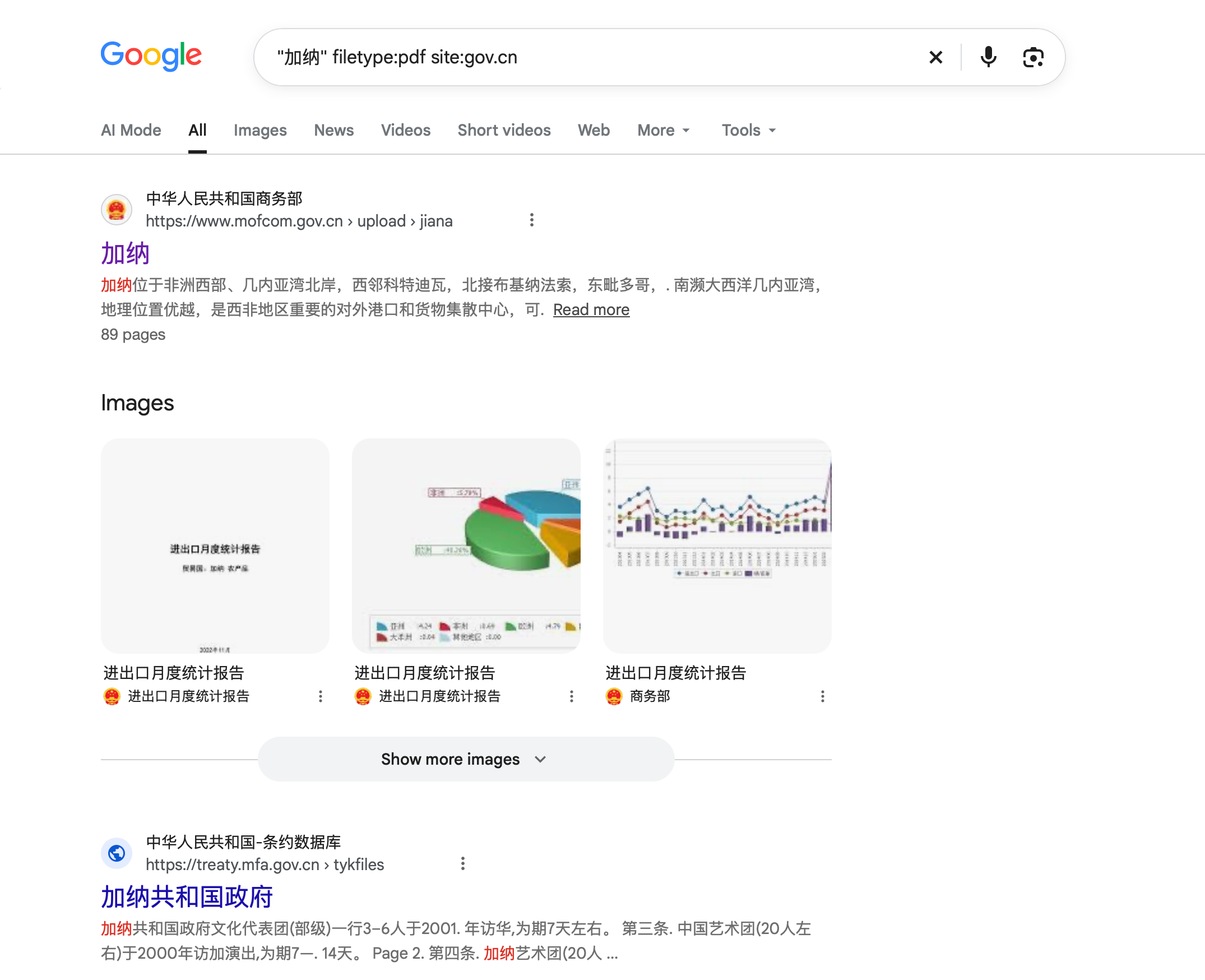
First hit: China’s Ministry of Commerce. They smell a commercial opportunity, and they wrote a country guide for Chinese investors abroad. Eighty-nine pages, 2025 edition.
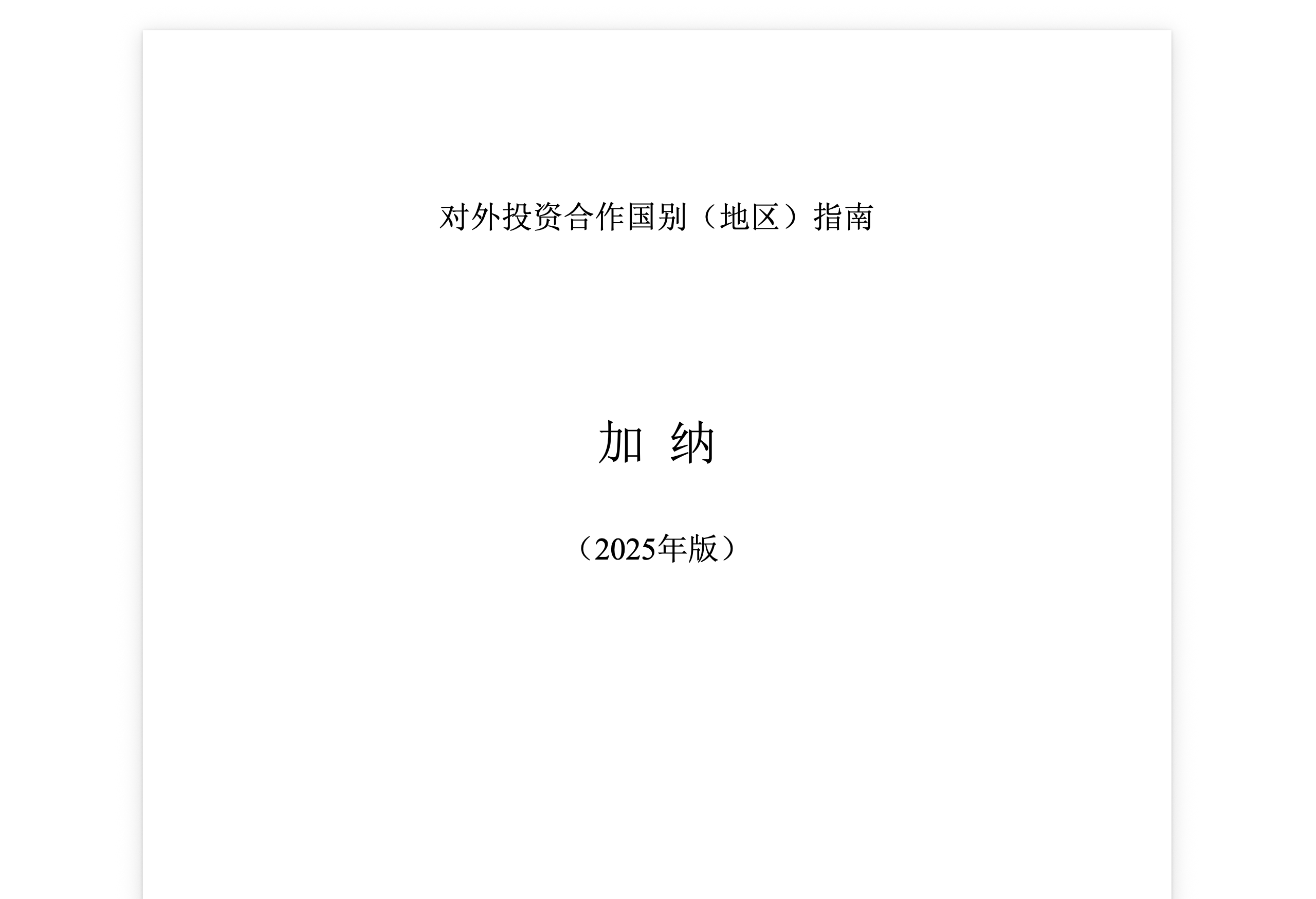
Oh, that’s interesting.
But how good is your Chinese?
Where OSINT stops and AI starts
This is the moment I leave open source intelligence and go to AI. The question is how to analyze a document like this and still be in control.
My next step is to upload the guide to Google’s NotebookLM. Whatever you ask, it’s all about the answers you get, and you shouldn’t trust AI just because it’s AI. NotebookLM puts small reference numbers (1, 2, 3, 4) next to each claim, so you can see what’s in the original text. If you don’t speak Chinese, and I don’t, those references aren’t that helpful.
When you see leads that look important for understanding the story, go to an official translator and work from there. But don’t ask them to translate the whole thing. About 90% of it is probably well known.
First, give the language model a fair chance to find something itself. I go to Claude and ask it to read the whole document and give me ten neutral questions I could ask about it.
Mind you, the word “neutral” is itself not neutral. So how does AI come up with a neutral set of questions? You give it the criteria. Don’t use adjectives. Don’t use bias. Don’t use this. Don’t use that. I have a formula for it, and when subjective questions still slip through, you iterate. (Why bother? Because you, as a human, are far too subjective. I wrote about that in Stop blaming AI chatbots. You are part of the problem.)
Technically, what we asked NotebookLM weren’t questions but requests for analysis. Jan and I agreed that this prompt was the most interesting to research further:
1. Macroeconomic Context & Stability: Assess Ghana's current economic trajectory, including debt restructuring progress under the IMF framework, currency and inflation trends, and new national strategies (such as the "24-Hour Economy" plan).
2. Sectoral Investment Opportunities: Identify priority sectors for foreign investment (e.g., mining/energy, digital infrastructure, agriculture/agro-processing, and transportation PPPs) along with key government targets.
3. Regulatory, Legal & Tax Framework: Summarize mandatory enterprise registration procedures (GIPC), minimum capital requirements, foreign ownership constraints (e.g., local content and GoldBod gold trading restrictions), land lease rules, and tax incentive structures (including Free Zones).
4. Operational Risks & Challenge Factors: Detail key operational risks, including foreign exchange/repatriation regulations, electricity supply gaps, labor union dynamics, environmental compliance, and commercial dispute resolution mechanisms.
5. Strategic Execution Checklist: Provide an actionable risk-mitigation checklist and step-by-step entry roadmap for an international company planning to invest or contract in Ghana.
One of the interesting findings was this:
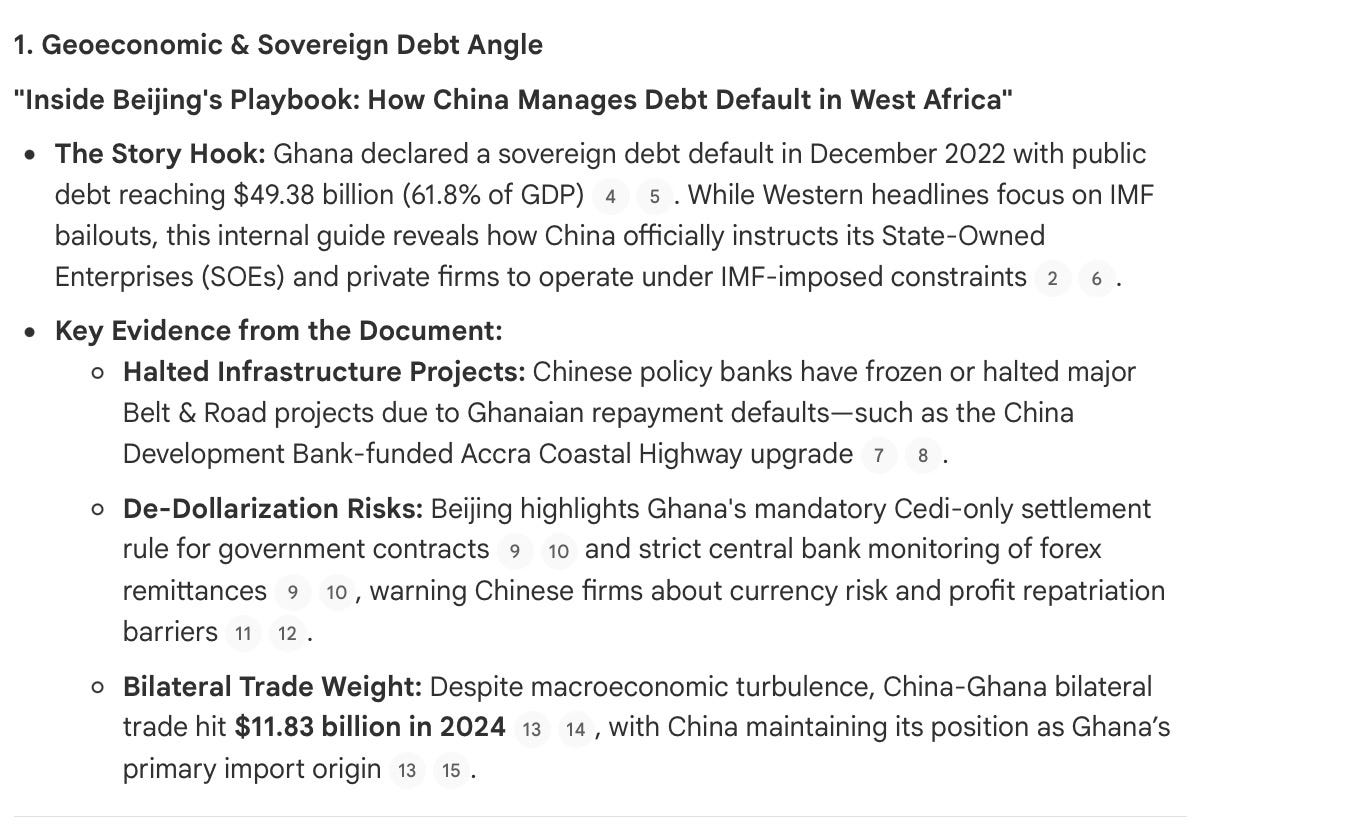
“Inside Beijing’s Playbook: How China Manages Debt Default in West Africa.” It sounds like a front page. Fun fact on page 34 of the Chinese guide: “the Ghanaian government is actively promoting the Chinese renminbi as a settlement currency for international trade”
One thing I know about NotebookLM: it’s a half-warm, half-cold model. Cold models stick to the text. Warm models get creative with the wording. Half-warm is fine for finding leads, but I wouldn’t publish on it. So I double-checked it with a colder model: I gave Claude the original Chinese guide and asked it to check each claim against the pages.
The numbers held up. The $11.83 billion in trade for 2024 is there (pages 3 and 31). So is the cedi-only (=currency) rule for government contracts from July 2025 (page 44). But in two places the wording is a bit too enthusiastic.
1. The debt figure sits next to the wrong date. NotebookLM: “Ghana declared a sovereign debt default in December 2022 with public debt reaching $49.38 billion (61.8% of GDP).” The guide, page 3: 于2022年12月19日宣布债务违约 … 截至2024年12月31日,加纳公共债务总额为7266.8亿塞地(493.8亿美元),占GDP的61.8%. The default was on 19 December 2022. The $49.38 billion is the debt on 31 December 2024. Both facts are correct, but the sentence reads as if Ghana had $49.38 billion of debt when it defaulted. You could argue “reaching” leaves that open. A reader will still take it as one moment in time.
2. “Chinese policy banks have frozen or halted major Belt & Road projects”. The guide names one project. Page 24: 加纳滨海大道项目升级改造工程由中国国家开发银行贷款 … 目前由于加纳未能履行相关还款义务,该项目处于停工状态 (“because Ghana failed to meet its repayment obligations, the project is at a standstill”). Claude searched the whole guide for 停工, 暂停, 停滞, 搁置 and 冻结 (standstill, suspended, stalled, shelved, frozen). This is the only halted project. “Major projects”, plural, is NotebookLM generalising from one example.
I’m just nitpicking here. Nothing was invented. The facts are right. The framing is just a bit louder than the source. That’s why you get reference numbers. And that’s why you use them and double-check them with another AI.
The alert
For Jan, the search "加纳" filetype:pdf site:gov.cn was the one that fit his research. So we turned it into a Google Alert. Now he hears from the Chinese government the moment they spot a new opportunity in Ghana.
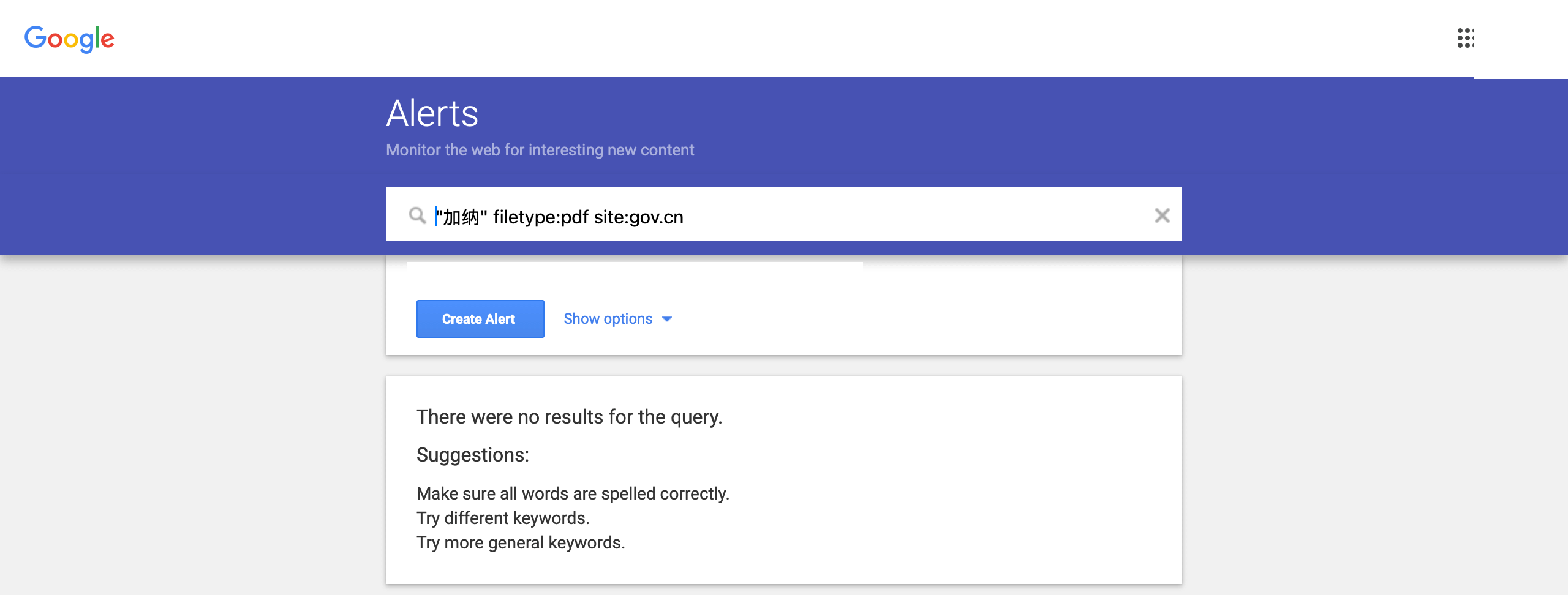
The preview comes back empty. That’s fine. It’s possible to get an alert anyway, by clicking show options. The settings are wrong.
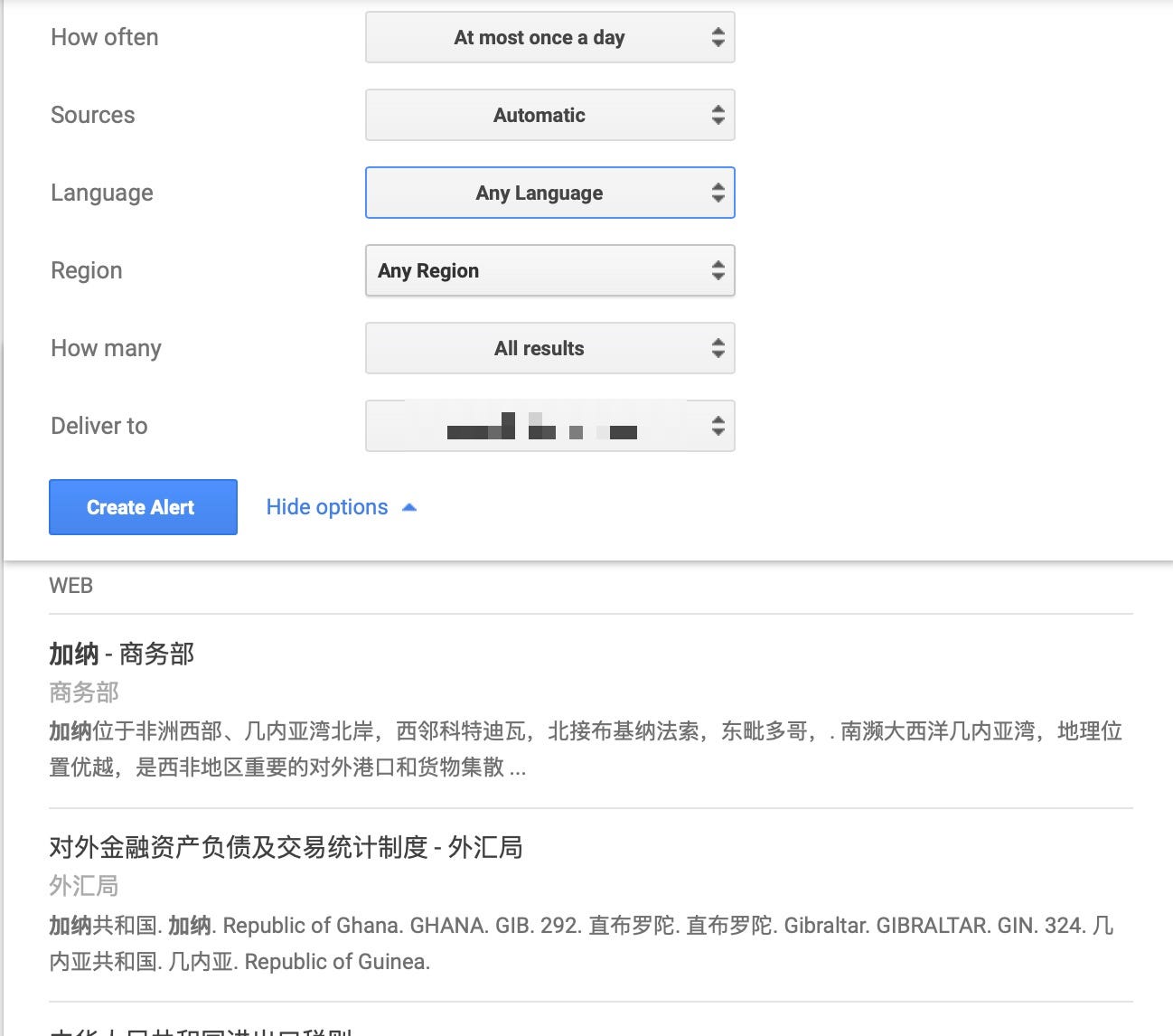
What can you do with this?
Take out Ghana, China and rare earths, and put in your own topic:
1. Find the people. Search Substack for [your topic]. Click every hit. Add /recommendations to the address of the best ones.
2. Find the country domain. Search for: [country] country domain
3. Check whether there’s enough material. Search for: filetype:pdf site:[domain]
4. Try other languages. Translate your keyword, then search for: “[translated word]” filetype:pdf site:[domain]
5. Loosen, then narrow. Search without quotes: [word] filetype:pdf site:[domain]. Then narrow to the government: [word] filetype:pdf site:gov.[domain]
6. Revive dead links. In the Wayback Machine, type [website]/*, click URLs, and filter the list on your keyword.
7. Flip it. Translate the country’s name, then search for: “[country in their language]” filetype:pdf site:[their government domain]
8. Analyze. Upload the document to NotebookLM, then check its claims with a colder model.
9. Stay on top of it. Turn your best query into a Google Alert.
Energy policy is Jan’s topic. Yours can be anything. The searches don’t care.
With OSINT you find the sources. With AI you analyze them.
Sources and links
Substack search: substack.com/search, query “rare earth and global energy policy”
The Rare Earths Trader, recommendations: therareearthstrader.substack.com/recommendations
Dead link: energycom.gov.gh/rett/downloads/project-reports?download=143:chinese-commissioned-reports
Wayback URL list: web.archive.org/web//energycom.gov.gh/rett/downloads/project-reports
Recovered report (download 143): web.archive.org/web/20201029074627/http://energycom.gov.gh/rett/downloads/project-reports?download=143:chinese-commissioned-reports
Ministry of Commerce, 对外投资合作国别(地区)指南 加纳 (2025年版): mofcom.gov.cn/dl/gbdqzn/upload/jiana.pdf
Antwi-Boateng (2020), on illegal Chinese small-scale mining: udsspace.uds.edu.gh
Stop blaming AI chatbots. You are part of the problem: digitaldigging.org/p/stop-blaming-ai-chatbots-you-are
All searches were rerun on 23 September 2026 in my own browser. Google results are personalised and will differ for you.