



In early January, YouTube announced it was “enhancing the search experience” by updating its filters. The platform renamed “View count” to “Popularity” — results were now based on undisclosed “relevance signals” — and removed the ability to filter by upload date, among other changes.
This article is reprinted with permission from Indicator, a publication by Craig Silverman and Alexios Mantzarlis that covers digital deception, OSINT tools, and investigative techniques.
Indicator's free weekly Briefing delivers the must-read news and must-try tools for digital investigators every Friday — subscribe for free here. They're also offering a special 20% discount to Digital Digging subscribers that provides 12 months of full access to Indicator's in-depth OSINT guides, investigations, intelligence reports, and a monthly workshop led by Craig
People were furious. “Removing this basic function will make it impossible to find breaking news from small channels with few viewers,” said one viral tweet. “Evidently, force-feeding people ‘curated’ slop is more important than site usability.”
YouTube replied to say that users could still sort videos by different date ranges. It was promptly hit with a Community Note:
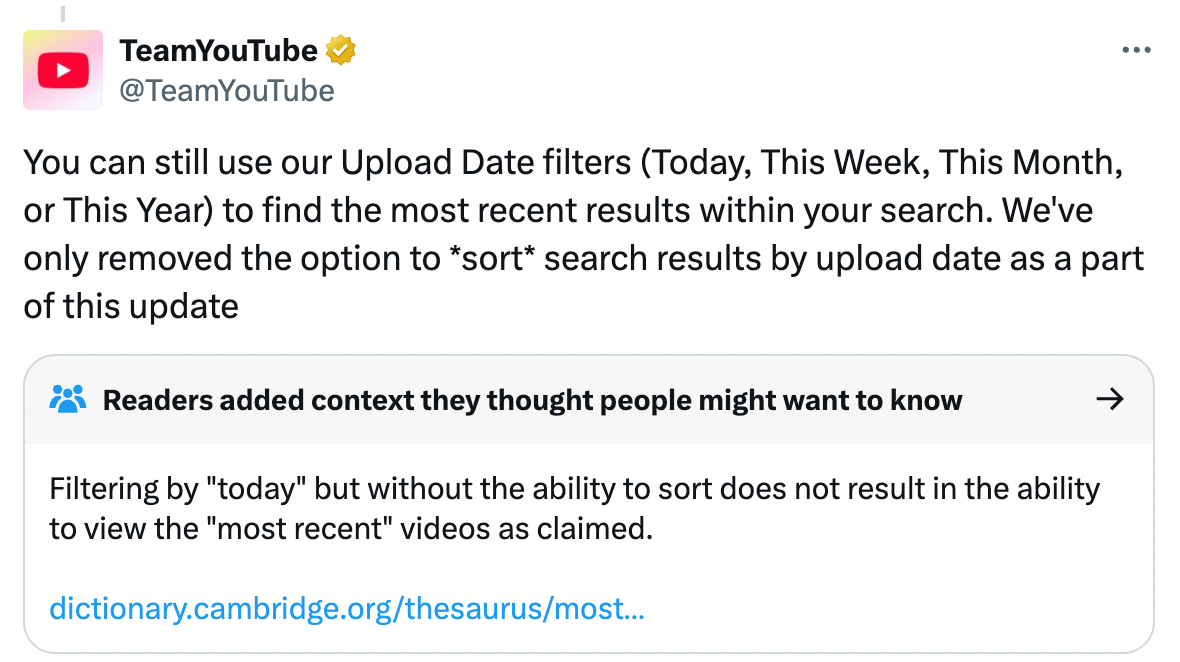
YouTube’s changes are a microcosm of what’s happening across platforms and search engines: useful features get removed, updates integrate AI and opaque signals, and power users feel ignored. The biggest shift from search engines that index information and match keywords to answer engines that interpret what you want and serve up AI summaries.
“Having used Google search since 1996, I am aghast at the results that come up on the first page now,” said Margot Williams, a longtime investigative researcher and the former research editor of investigations at The Intercept.
She said results typically lead with an AI summary “and then Wikipedia entry as the top result, then the list of questions of ‘what other people are asking,’ maps, weather, images and of course the ‘sponsored’ results and the other crap feeding Google coffers. If I wanted images or videos I would ask for them.”
The reason is simple: Google (and Bing and others) are for-profit consumer search engines. Most users want quick answers, not pages of results. And search companies want to earn revenue. We professional searchers—journalists, investigators, researchers—aren’t the target audience.
So we adapt. That means taking the “hard way”: mastering operators to force engines to take queries literally; mixing browsers, search engines, and VPN endpoints; and using LLMs as research companions, rather than replacements, for search and research.
“It gets way more important for professional researchers to use every trick in the book,” Henk van Ess told me.
Van Ess is a longtime online search and research trainer, a fount of Google tricks. But now he rarely uses Google for general searches. Instead, van Ess has shifted to teaching people how to use AI to find and analyze information. And he’s vibe coding, too.
“My thing is to find the story in data,” he said. “I happily burn my ships if there are better and smarter methods to find a story in big data.”
His evolution shows the challenges and opportunities presented by the rapidly evolving world of online search.
This guide draws on insights from OSINT and research professionals to offer an overview of the changing landscape, how investigators are adapting, where AI helps and hinders, and practical strategies for finding what you’re looking for.
I’m grateful to Rae Baker, Nico Dekens, Henk van Ess, Ritu Gill, Marcus Lindemann, Alicja Pawlowska, Kirby Plessas, Sofia Santos, Karina Shedrofsky, Claudia Tietze, and Margot Williams for sharing their insights.

